The Excel MIN function returns the smallest number in a set of values. Use it to find the lowest sale, score, price or the earliest date.
number1 |
The first number, cell or range, such as C3:C8. |
|---|---|
number2, ... optional |
More numbers, cells or ranges, up to 255 in total. |
Table of Contents
Basic example
To find the lowest January sale, give MIN the January column:
=MIN(C3:C8)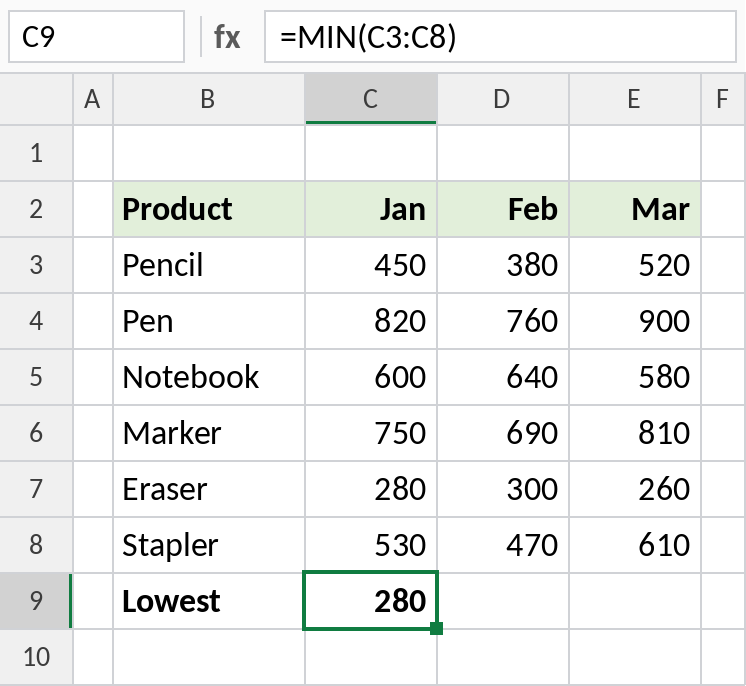
The smallest value in C3:C8 is 280, for Eraser.
Lowest value in a whole table
Give MIN a block of cells to search all three months at once:
=MIN(C3:E8)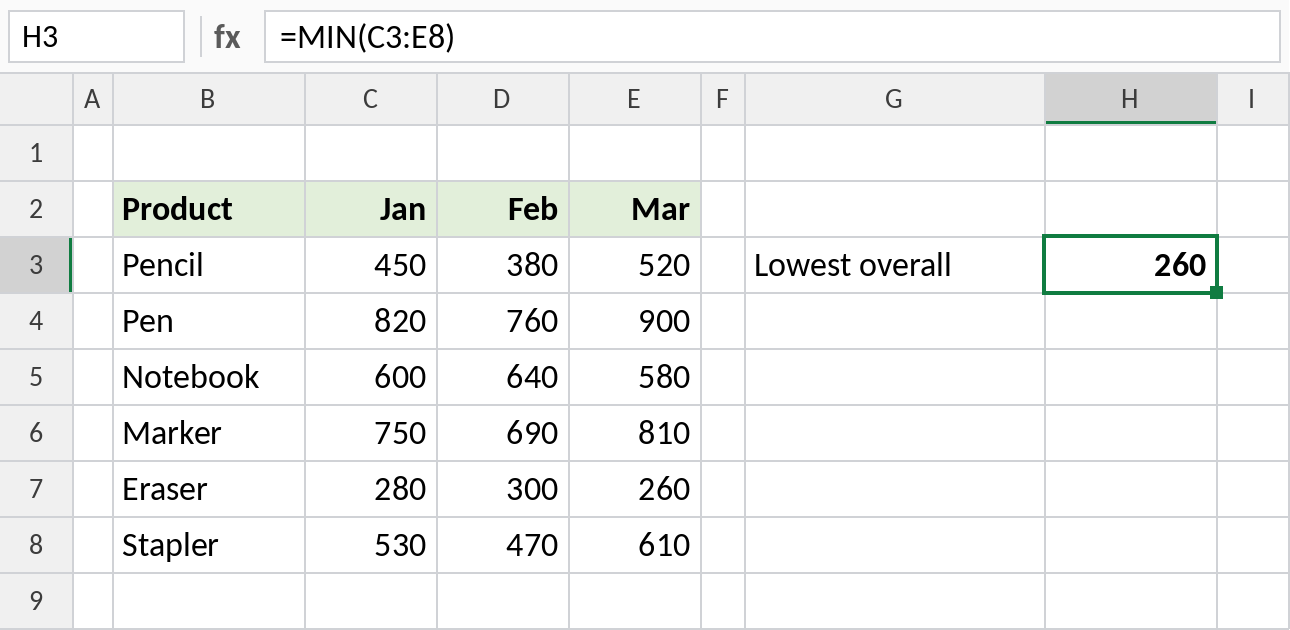
The lowest sale across January to March is 260, Eraser in March.
Find the item with the lowest value
Combine MIN with INDEX and MATCH to return the name of the product with the lowest sale:
=INDEX(B3:B8,MATCH(MIN(C3:C8),C3:C8,0)) 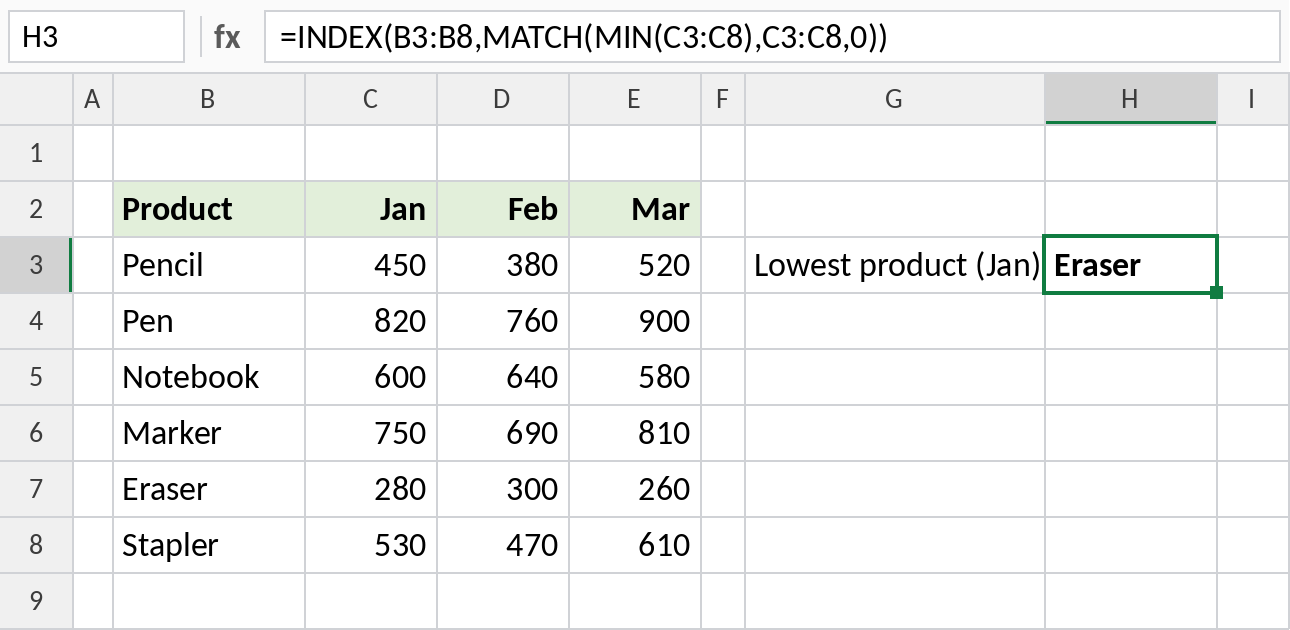
MIN finds 280, MATCH finds its position (5), and INDEX returns Eraser. In Excel 365 you can use =XLOOKUP(MIN(C3:C8),C3:C8,B3:B8) instead.
MIN and related formulas
| Formula | Result | What it does |
|---|---|---|
=SMALL(C3:C8,2) |
450 | Second-lowest January sale |
=MINIFS(E3:E8,C3:C8,">500") |
580 | Lowest March sale where January was over 500 |
=MIN(C3*10%,40) |
40 | Caps a 10% bonus at 40 |
=MIN(C3:C8,500) |
280 | Lowest of a range and a fixed number |
Notes
- MIN ignores text, empty cells and TRUE/FALSE inside ranges.
- If there are no numbers, MIN returns 0. Watch for this with dates: an empty range shows as 00-Jan-1900.
- Dates are numbers, so
=MIN(dates)returns the earliest date. - MIN is often used to set a maximum:
=MIN(value,cap)never returns more than the cap.
Common errors
| Problem | Cause | Fix |
|---|---|---|
| Result is 0 | No real numbers in the range, or a zero you didn’t expect | Check for numbers stored as text; use MINIFS(range,range,"<>0") to skip zeros |
#N/A, #VALUE! |
An error cell inside the range | Fix the source, or use AGGREGATE(5,6,range) |
| Earliest date shows 00-Jan-1900 | The date range is empty | Wrap it: =IF(COUNT(range),MIN(range),"") |
Practice file
All three examples plus the related formulas in a cheat sheet.