When a formula has more than one operator, Excel doesn’t simply work left to right. It follows an order of operations: brackets first, then powers, then multiplication and division, then addition and subtraction. Knowing the order, and a couple of Excel-only surprises, prevents wrong results.
Brackets change the result
Multiplication comes before addition, so Excel works out 5*2 first:
=4+5*2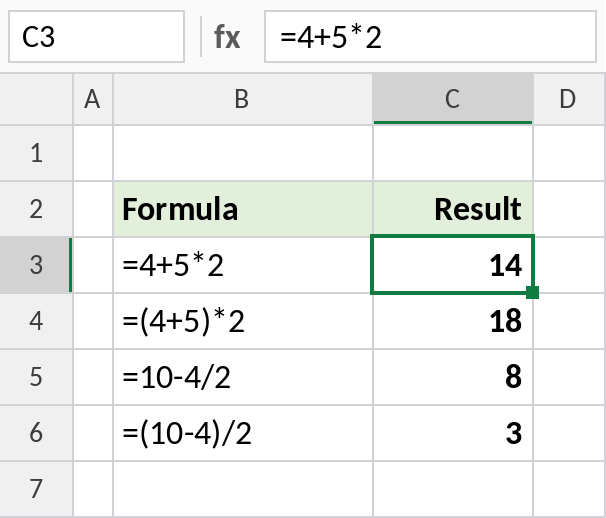
=4+5*2 is 4 + 10 = 14. Put brackets around 4+5 and Excel adds first: =(4+5)*2 is 9 × 2 = 18.
How the formula works
- Excel first looks for brackets and works out the innermost ones first.
- Next come negation, percentages and powers (
^). - Then multiplication and division, from left to right, then addition and subtraction, from left to right. Joining text (
&) and comparisons (=,<,>) come last.
Two Excel surprises: negative numbers and powers
In maths, −2² is −4. Excel applies the minus sign *before* the power, so it squares −2:
=-2^2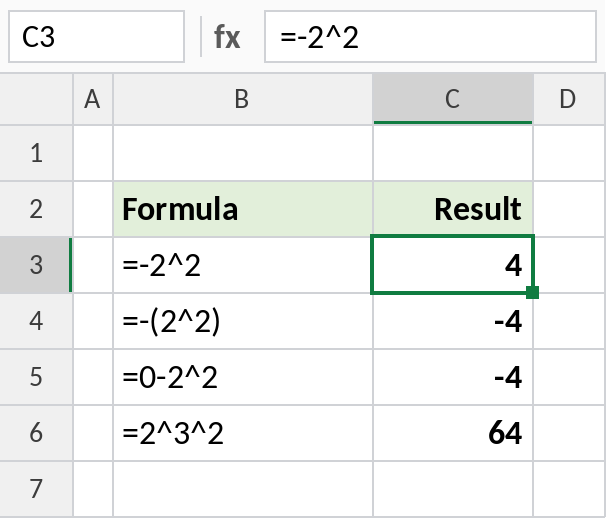
=-2^2 returns 4. Write =-(2^2) to get −4. Also, Excel works out repeated powers left to right: =2^3^2 is (2³)² = 64, where maths gives 512.
A real formula with a discount
To apply a 10% discount to 4 items at ₹500, the bracket around 1−D3 matters:
=B3*C3*(1-D3)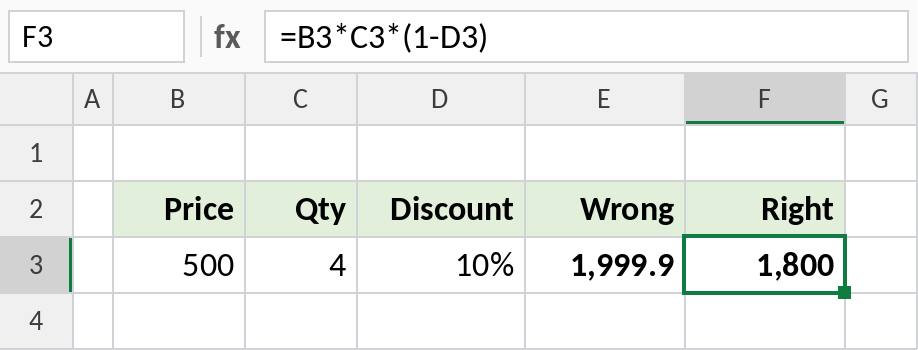
Without brackets, Excel multiplies first and then subtracts 0.1: ₹1,999.90. With brackets, you get the right total, ₹1,800.
Excel's full order of operations
| Order | Operator | Meaning |
|---|---|---|
| 1 | ( ) |
Brackets |
| 2 | : , and space |
Reference operators, as in A1:A10 |
| 3 | - |
Negation, as in −5 |
| 4 | % |
Percent |
| 5 | ^ |
Exponentiation (power) |
| 6 | * and / |
Multiplication and division, left to right |
| 7 | + and - |
Addition and subtraction, left to right |
| 8 | & |
Joining text |
| 9 | = < > <= >= <> |
Comparison |
When in doubt, add brackets. They never hurt, and they make a formula easier for others to read.
Notes
- Operators at the same level, such as * and /, are worked out left to right:
=12/3*2is 8, not 2. - Comparison comes last, so
=A1+1>5adds first and then compares. - To step through a formula and see each stage, select the cell and use Formulas → Evaluate Formula.
Common errors
| Problem | Cause | Fix |
|---|---|---|
| Result is too big or too small | Missing brackets | Bracket the part that should be calculated first |
| Negative power gives a positive result | Negation is applied before ^ | Write =-(2^2) |
| Brackets don’t match | An opening bracket without a closing one | Excel colours each pair; count them |
Practice file
All three examples, plus a practice sheet of formulas to predict before checking.